




What Is TDS and How to Measure It?
by
Dr. Jonathan Doyle - Updated February 10, 2025

What is TDS in water?
TDS stands for Total Dissolved Solids and represents the total concentration of dissolved substances in water. TDS is the term used to describe the inorganic salts and small amounts of organic matter present in solution in water. The primary components of TDS are usually calcium, magnesium, sodium, and potassium cations and carbonate, hydrogencarbonate, chloride, sulfate, and nitrate anions.
TDS in water supplies can originate from natural sources, sewage, urban and agricultural run-off, and industrial wastewater. The salts used for road de-icing in wintertime can also contribute to the TDS loading of water supplies.
Is Low-TDS water harmful?
Based on a report by the Water Quality Association, water low in TDS is defined as that containing between 1-100 milligrams per liter (mg/l) of TDS. There is no scientific data to prove that drinking water with low TDS will have adverse health effects. In fact, low TDS means the water quality is excellent, but it tends to have a flat taste.
What happens when we drink high-TDS water?
Just because water has high TDS levels doesn’t mean it is detrimental for human health. Like what we have discussed for the low-TDS water, there has been no research from any governmental agency giving scientific proof that high-TDS water will cause health concerns. Yet, the elevated TDS will affect the water taste and the service life of the appliances. Water with high TDS tends to have a bitter, metallic, or salty taste, sometimes even along with discoloring water and unpleasant odor.
What is the ideal drinking water TDS level?
Since the TDS levels do not have a direct correlation with adverse health effects, the recommendations of drinking water are made only for aesthetic and taste preferences with no health criteria. Calcium, magnesium, hardness, and alkalinity conditions (in municipal limits) do not affect the safety of drinking water.
A review was conducted of the United States, Canada, World Health Organization (WHO) and European Community (EC) drinking water standards. None have minimum limits or optimum levels of total dissolved solids. The US recommended maximum level is 500 mg/L, as is the Canadian guideline.
| TDS Level in parts per million(ppm) | Palatability Quotient |
| Less than 300 | Excellent |
| Between 300 and 600 | Good |
| Between 600 and 900 | Fair |
| Between 900 and 1200 | Poor |
| Greater than 1200 | Unacceptable |
How to measure the total dissolved solids?
TDS is measured on a quantity scale, either in mg/L or, more commonly, in parts per million (ppm). Meaning that, if the TDS level is 300ppm, this means that out of one-million parts of water, 300 of those parts are something else.
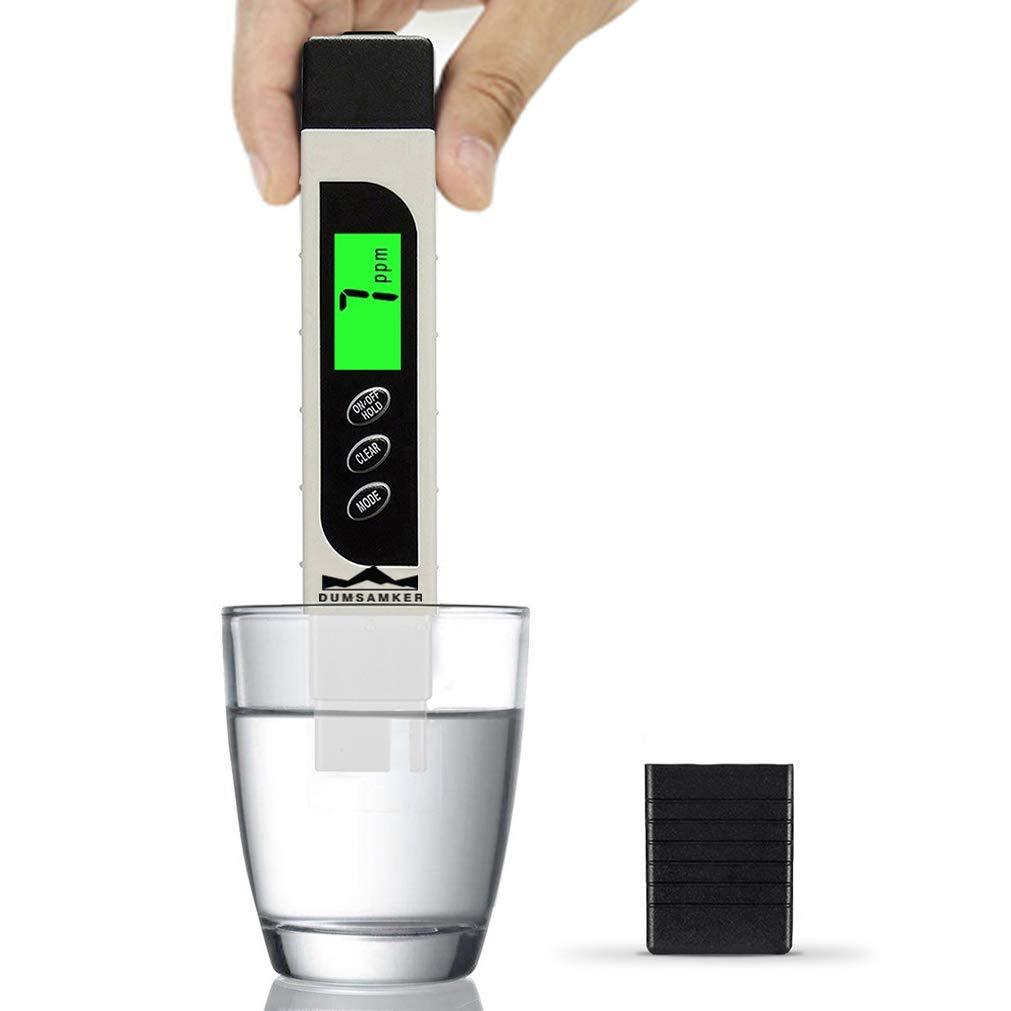
The easiest way to measure the TDS in water is through a TDS meter, which is a small hand-held device with a screen to indicate the TDS reading. The TDS meter is usually inexpensive and accessible either on Amazon or local appliance stores like Home Depot. To measure the TDS, simply submerge the tester’s probes into the solution you want to test and record the results.
How to reduce TDS in water?
If you test the TDS and find out your drinking water TDS is above 500 ppm or higher, you might consider improving the water taste. The effective way to reduce or remove the TDS in water is to utilize a water treatment system.
Below are three water filtration systems we recommend to reduce high levels of total dissolved solids in your tap and drinking water:
Reverse Osmosis (R.O.)
The reverse osmosis water filtration method relies on a semi-permeable membrane to filter out impurities from drinking water. The membrane contains microscopic pores which will allow only molecules smaller than 0.0001 microns to pass through. As the molecules of dissolved metals and salts are large compared to the water molecules, water squeezes through the membrane leaving the metals and salts behind.

Distillation
This kind of water purification system offers clean water through boiling and producing water vapor. When water vapor rises and reaches a cool surface, it will condense back to the liquid form. The dissolved salts and other particles are unable to vaporize thus remain in the boiling solution.

Deionisation (DI)
By definition, deionization (DI) is the removal of all ionized minerals and salts (both organic and inorganic) from water through the process of ion exchange. Ions are electrically charged atoms or molecules that have either a positive or negative charge. The DI happens when water passes through a mixed ion exchange bed where both positively and negatively charged resins are used to remove their respective ions. The process is similar to water distillation but much more efficient in terms of time and energy usage.

Choose Your Water Solutions
- Countertop RO Systems No Installation, Easy Everyday Use
- Undersink RO Systems High Flow, More Space Under the Sink
- Water Filter for Sink Stay Hydrated Always
- RO System Replacement Filters Change Your Filters Regularly
Categories
- Buyer's Guide Complete buying guides to help you choose wisely
- Water Contaminants Offer the best solution to solve the water problems
- Water Stewardship Responsibility for sustainable water management
- Home and Wellness A better and healthier world for individuals and families
- Explore Waterdrop Discover water filtration solutions for every home.


